


New Airconditioning Rules in Spain - Energy Saving Measures
New Airconditioning Rules in Spain 8th August 2022 - New Energy Saving Measures. Last week the Spanish Government approved energy saving measures which, in some cases, will be in force from midnight Tuesday 9th August until 1st November 2023 and will affect all premises open to the public such as offices, shops, bars, restaurants and public transport systems and transport centres.
These rules are part of Spain's drive to cut its gas use by 7% under a recent European Union deal to reduce their dependency on Russian gas supplies.
With Spain currently experiencing a very hot summer, with temperatures above 40ºc in some areas, many in the tourism sector have criticised these new measures.
The government state that the measures "will not only save energy but will also bring down bills for households and businesses".
Keep up to date with the Weather in Benidorm HERE
The most important rules are as follows:-
Summer Season
TEMPERATURES: From Wednesday, all businesses using air conditioning systems must ensure that the air temperature is set at a minimum of 27ºc This may vary slightly depending on the activity and the health and safety regulations in force such as certain activities in the hospitality sector in which 25ºc is the limit, hairdressers, gyms, laundrettes, schools, playschools amongst others.
Stores will be required to keep their doors shut to maintain temperatures..

New Airconditioning Rules in Spain
Winter Season
Temperatures will be set at a maximum of 19ºc
Doors and windows to be kept closed when equipment in use.
In both cases the relative air humidity should be kept between 30% and 70%.
Temperature and humidity monitor must be installed in order to ensure compliance.
LIGHTING: All shopfront lighting must be switched off by 22.00.
SIGNS: Signs or screens must be on show at the entrance of the premises or building indicating information on temperature, humidity levels and other measures taken to ensure the reduction in energy usage.
DOORS: All premises that use air con and/ or heating and that have direct access from the street must have a self-closing door mechanism. This must be in place by 1st October.
Hotel Rooms
Tourists can continue to keep their hotel rooms chilled, as they are considered to be "private spaces", but all other public areas will have to abide by new laws.
Join Benidorm Seriously on Facebook for all the latest news and information.
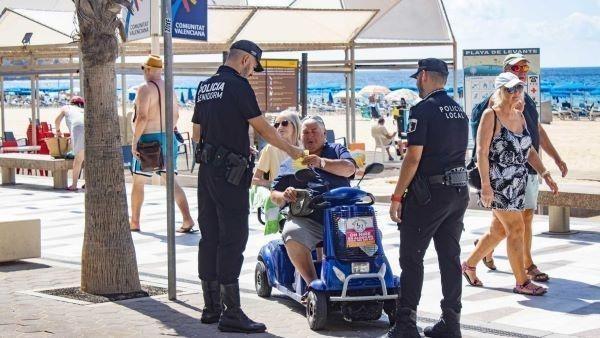
Benidorm Mobility Scooter Rules
Mobility Scooter Rules - Benidorm, July 2022 We all know how popular mobility scooters are here in Benidorm but these can cause problems for other pedestrians and motorists, and after numerous complaints from drivers and pedestrians in Benidorm, the town hall has announced tighter controls in the face of multiple breaches on public roads.
Municipal sources calculate that in the city more than 500 motorized chairs are marketed daily.
The Department of Mobility of Benidorm City Council, hand in hand with the Local Police, have intensified control over the rental and use of personal mobility vehicles and a campaign has been put into operation to cover two problems: To inform the establishments that are responsible for the rental of these vehicles and to do the same with users, making sure they know the rules in place.
The mayor recalled that Benidorm was "one of the first municipalities in Spain" to regulate the rental and circulation of this type of vehicle and translate it into a municipal ordinance, to insure "the greatest guarantees of safety for all road users, mainly pedestrians".
Benidorm Mobility Scooter Rules
Rental of Mobility Scooters
The ordinance establishes that the rental of these self-propelled wheelchairs (mobility scooters) is limited to people with accredited mobility problems and with disabilities, you should be asked to show either a blue badge or a letter of need from your GP or those who are over 55 years old. Failure to comply with the regulations could result in a fine of up to 500 euros.
Users - Mobility and Scooter users.
The misuse of these vehicles, which circulate at speeds higher than allowed or on footpaths where they are prohibited (scooters), causes numerous complaints from drivers and users and damage to pavements etc
The ordinance generally prohibits these vehicles from circulating on the sidewalks, except in the cases of people with reduced mobility or functional diversity who may do so at a maximum speed of 4 kilometres per hour, the average speed of pedestrians.
The Local Police are in charge of informing and reminding users of the content of the ordinance, emphasizing where these vehicles can circulate and the speeds at which they can do so, and serious infractions can once again lead to fines of up to 500 euros.
These personal mobility vehicles cannot circulate on the bike lanes located on the sidewalks, but they can circulate on the road, on single-platform streets where the passage of vehicles is authorized, they may circulate at a maximum speed of 20 kilometres per hour, as well as on the road respecting that same speed; while only the smallest skates will be able to travel through the parks.
Scooter Users (Not Mobility) - All users of this type of vehicle are obliged to drive with a helmet and with civil liability insurance these must not be ridden on footpaths.
Remember - The municipal laws that cover their use, allow for fines of 500€ for misuse of the vehicles.
In Summary: Our Understanding of the law is
Neither Mobility Scooters nor Stand Up Scooters may be used in Bike Lanes
Stand Up Scooters are restricted to the Road only. A helmet must be worn and there is a maximum speed of 20km per hour
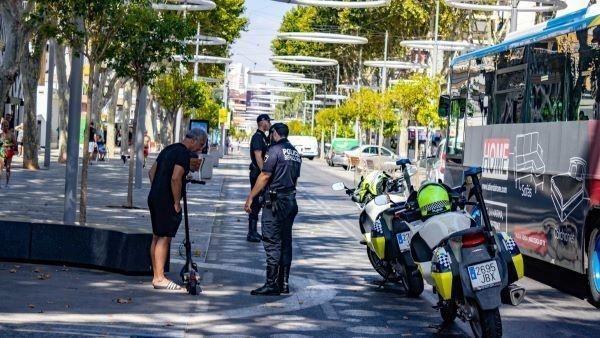
Mobility Scooters may be used on Footpaths but with a maximum speed of 4km per hour. They may be used on Roads with a maximum speed of 20km per hour. The exception to this is if the bike lane is on the footpath, then they may only be used on the road.
You MUST be disabled or over 55 years of age to be permitted to rent a mobility scooter.
Road signs (stop, give way, speed limits, traffic lights, one way traffic etc) are applicable to all road users, including those using Mobility Scooters or stand up scooters
Again please note this is our understanding of the law. Please inform admin if you believe we are incorrect.
Note - This article has been translated from Spanish to English so some details may be lost in translation, read the original article here.
Find Mobility Scooter Hire Here.
Join Benidorm Seriously on Facebook

Butterfields Mobility Benidorm - Scooter Rentals, Sales and Repairs
Butterfields Mobility Benidorm - Scooter rentals, sales and repairs - Are you looking to rent or buy a scooter, no problem, Butterfields are here to help.
Butterfields is not just a mobility company; their mission has always been to provide their clients with perfect service from start to finish.
Butterfields' have 2 showrooms. Find the large, impressive showroom on Avenida Mediterraneo, no 66 local 13 (click for a google interactive map), call in for help and advice or telephone (+34) 865 839 404.
At Butterfields you can even rent children's car seats and buggies

or Butterfields Mobility on Avenida Castello
Rentals - There are so many amazing rental options for you to choose from, it will be hard to pick only one.
Sales - Find a wide range of new and used mobility scooters, scooters and bikes available to purchase today.
Repairs - Butterfields Mobility offer Servicing and Repairs for Mobility Scooters, Scooters and Electric Bikes.
Mobility Scooter Rentals
Choose from single mobility scooters to double limos.
Hire a Single Mobility Scooter from just 10€ a day.
Hire a DOUBLE LIMO from just 30€ per day.
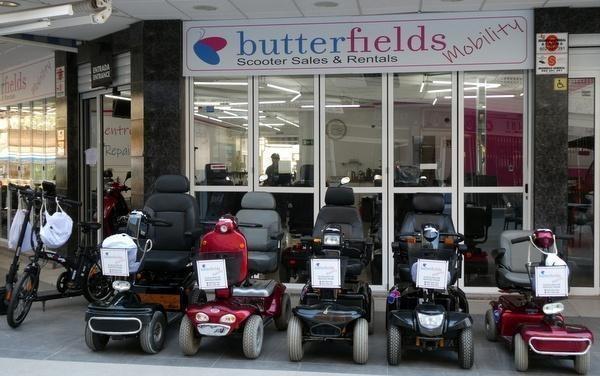
Butterfields are proud to announce that they are the first company to be able to offer you legal rental of
*ROAD LEGAL DOUBLE MOBILITY SCOOTERS*
*** 25 years plus with a driving license for a minimum of 5 years required***
RESERVATION ADVISED CALL +44 7879 015764
Looking to explore Benidorm in a different way, why not hire a Fold up bike, E-Bike, Electric scooter or Segway.
Servicing and Repairs
Butterfields Mobility is your No. 1 choice for Cleaning, Servicing, and Repairs in Benidorm and Surrounding Areas.
Scooter Service
It is recommended to service your scooter every six months, just as you would with a car, a general check-up just to check for any issues, test the battery levels, and give it a good clean.
A Butterfields Scooter Service Costs just €25 (Incl. I.V.A)
Need a NEW Battery?
We have the best priced batteries in the area, we have a wide range in stock but if we do not have what you, it will be delivered within 1 week.
All Batteries come with free fitting, if you don’t know the size of your Battery, just pop down and Butterfields will check the size for you, Some Batteries can even be fitted on the same day, to check when you can get your batteries fitted or to book a fitting, call us on +34 623 526 084.
New Mobility Scooters
Butterfields have a wide range of new Single + Double Mobility Scooters for sale. All sold with a 12 Month Guarantee.
Second Hand Mobility Scooters
We also boast a selection of over 50 high quality, used Mobility Scooters, all sold with a 3 Month Warranty.
E-Bikes + Electric Scooters
Check out their range of new and used E-Bikes and Electric Scooters for sale.
Chargers + Accessories
Butterfields also stock a range of New + Used Accessories and Chargers for E-Bikes, E-Scooters and Mobility Scooters, including, Helmets, Covers etc.
Visit Butterfields Mobility online at www. butterfieldsmobility.com

Benidorm Walking Football - Benidorm CD social football group FC
Do you miss your youth? Do you long for the good old days when you could go out for a "kick around". With Benidorm Walking Football the good old days are back.
Every Wednesday, at Noon we meet for Walking Football at the Artificial playing fields (Antonio Lopez pitch) just behind Imed Hospital in the Rincon de Loix, only 3€ per session.
See our Facebook Page HERE

We use the term "walking football" loosely. Many of us are over 50 years of age and choose only to walk. That does not mean you must be over 50. We have players of all ages and women are also very welcome, (ages range between 35 and 70 years!) We try to balance the teams to make sure each side has its share of runners and walkers. The only strict rules are no sliding tackles, or tackles from behind and the ball must stay below head height. Trainers must be worn, no boots with studs.
With such a mix of ages, shapes sizes and skills it doesn’t matter how good you are or aren’t – it’s taking part that counts and we welcome anyone who wants to play with open arms.

Tourists Welcome
Even if you are just on holiday for a few weeks, come and join in the fun. It would a great way to spend an hour for Stag (and hen) parties as tourists are always very welcome. And for those of mature age to keep active. If there are sufficient numbers and you would like to organise a competitive match between your group and ours let us know.
Find out where to watch LIVE Sport in Benidorm.
Join the Benidorm Seriously on Facebook
If interested complete the form below, so that we know when to expect you.

Scattering ashes in Spain
Scattering Ashes in Spain is not a pleasant subject to cover but one we get asked a lot about.
Scattering of Ashes.
Ashes cannot be scattered just anywhere in Spain nor in the Sea, near the coast/beach they have to be taken out on a boat a pre-defined distance from the shore, there are specific rules and laws as to the scattering or strewing of them, it is a punishable offence to do this in Spain with fines up to 15,000€ in some areas.
To scatter ashes in the sea permission has to be obtained from the relevant government ministry or marine authority or through a funeral parlour authorised by the authorities to do so, ashes need to be in a biodegradable urn to allow it to sink in the sea (funeral parlours sell them made of salt for marine purposes)
Please contact the local town hall for up-to-date information as each town hall has its own rules and regulations that need to be followed.
Bringing ashes on the airline.
The carriage of ashes is permitted as cabin baggage and may be carried in addition to your single permitted piece of normal cabin baggage provided that a copy of the death certificate and the cremation certificate accompanies them. You must ensure that the ashes are securely packaged in a suitable container with a screw top lid and protected against breakage.
Feel free to discuss this topic in the Benidorm Social Club or on Our Facebook Group
If you require further assistance on this subject, please feel free to contact our admin team who will be happy to help you find professional legal advice.